All Free Today

Leave a comment

If the title of this post sounds familiar, you’ve probably seen Chitty Chitty Bang Bang at some point in your life.

But the topic today is not Benny Hill’s acting career or whether Toot Sweets would have made a great candy. We’re here to talk about how much access we have to FREE information during the College Search process.

And if the topic seems somewhat familiar, I’ve touched on the availability of free “stuff” both in my “Unexpected Friends” post on 11/10/10 and my “One Night in Plattsburgh” post on 12/15/10.  I think it’s a topic worth emphasizing.

You pay enough for college. It’s a fantastic investment, but it is rarely cheap.   Therefore, families look for any savings or deals they can find.  However, when it comes to the information and services needed during the search for College,  families often end up paying for things that they could have obtained for free.  Or they don’t obtain the information or receive the service at all because they think they can’t afford it.

Here a few of the items that are free – no charge – zilch – zero – gratis. I’ve come up with 8 categories of things that are ALL FREE TODAY:

1) Guidance Counselors and the Guidance Office – Ultimately, your taxes (if your child attends a public HS) or your tuition dollars (if he or she attends a private school) do pay for this, but in terms of direct costs, you have a paid staff professional staff member, support staff, paper and electronic access to thousands of books and other periodicals about colleges and the college search.  All at your disposal, with no admission price.  While many are overworked and some are better than others, in general, you have a committed, educated, caring person (or two or three) willing to help you achieve your goals.

2) College Admissions Counselors and Admission Offices – On the other side of the fence, you have an admission counselor who recruited you, is reviewing your file, has a responsible for recruiting cool people like you from their “territory” and went into the position because they like helping people like you.  And they are free (somebody else’s tuition is paying for them – at least for now).  He or she is specifically trained to answer your questions.  And the support staff, generally, are similarly well versed and also – almost always – quite friendly.  And the materials available through the Admissions office are informative, diverse and – yes – FREE.  (Some schools will charge for a PRINT catalog.)

3) The FAFSA – It is the FREE Application for Federal Student Aid.  Free.  No Charge.  It does not cost you a dime to find out if you are eligible for federal grants, loans and scholarships.  If you pay anyone to fill out a FAFSA for you, you should pay only for the convenience of not spending 45-60 minutes filling out a form. Anything more expensive than that should be filled under wasted money (or, in some cases, fraud).  I would strongly suggest that you NEVER pay someone to complete a FAFSA for you.

4) College Fairs – At your high school, your community college, at convention centers – there are college fairs seemingly every day and night.  I can attest to that from years in the field.  And, while my College had to pay to attend some of the bigger fairs, these events are all free to you.  No charge to visit with hundreds of college representatives from around the country – colleges that WANT to talk to you and share their “sales pitch”.  And give out FREE pens and flash drives and rulers and markers and key chains and lanyards and…………………

5) The Library and – to some extent – Barnes and Noble – Some of the Colleges that you are looking at can be pretty far away.  And your guidance office might not have EVERY College Search book (although I bet their catalog matches the library and B&N).  But the hours, quiet, convenience, and – in the case of Barnes and Noble – beverages and pastries (those are not free) – allows you to do your college research in a relaxed environment without the distractions of a high school guidance office.  And, if you are a parent reading this (like, I suspect most of you are), then I assume you would definitely prefer doing research someone other than the high school guidance office.

6) The World Wide Web – From www.fafsa.ed.gov to www.finaid.org, there are a plethora (trying to use that word in all my blogs now) of excellent online financial aid resources – all free.  In fact, that is the clearest indication that the site is worthwhile and legitimate.  If it costs something, run away.  But, also keep in mind that each college has a detailed website with courses, costs, admission policies and much, much more.  As well as – for most of them – Facebook pages and YouTube channels and Twitter accounts….

7) Viewbooks and Videos and Flash Drives and Catalogs and Search Pieces and Brochures – I’ve covered this a bit in the other bullet items above, but the Colleges (other than a few print catalogs) are not charging for their information.  They want you to have it.  Many trees die, as it were as millions of viewbooks and brochures are mailed out handed out to people like you.  All free.  And while they are generally glossy and filled with slogans, there is usually quite a bit of nutritional value beneath the candy coating – courses and mission statements, career paths and student service options, and much, much more.

8) Family and Friends – More so than at any other time in history, you know people who went to college – friends, family and neighbors.  And they are not being paid by a college.  And they are usually more than willing to “tell it like it is” (or was).  Just bear in mind that the information is from their unique viewpoint and may be outdated, if they went to school a few years ago.

So, only pay for what you should pay for.  And enjoy the ride.   I’m off with Caractacus (played by Dick Van Dyke) to find the Bulgarian castle where SATs are made (see below):

The Educational Testing Service's "Secret Lair"

The Educational Testing Service's "Secret Lair"

As always, I welcome your comments, your ratings, your Facebook posts and your emails.  I can be reached at info@cc4therestofus.com, on Facebook at “College Counseling for the Rest of Us”, on Twitter @MichaelCCR and by cell at 908-403-3819.

The Art of Candy Stripping and the Trumpet Player on the Moon

Leave a comment

The College Admission Essay (also known as the Personal Statement) is one of those “qualitative” opportunities provided to candidates to go “beyond the numbers”.

It is so easy to focus on grades and SATs, grades and SATs and – even – grades and SATs when talking about College Admissions.  “What kinda SAT do I need to get in to this school?” was definitely one of the most popular questions I received at high school College Fairs over the years.  But I can never stress this enough: COLLEGE ADMISSIONS FOLKS LOOK AT MORE THAN WHAT YOU DID ON ONE OR TWO SATURDAY MORNINGS!!!

Sorry for shouting, but one of the great ironies of the College Admission profession is that – at least in my humble opinion – parents are far more focused on SATs than College Admissions officers are.  While SATs (and grades, you can never forget grades) are key components of the Admission Decision Process, the courses taken are equally important.  I abhor the bias (2 common SAT words, free of charge) against admission counselors on this issue, when it is not deserved (in most cases)!

Unless we offer a strong basket weaving curriculum, I am far more interested in what College preparatory courses you took than how you did in the ubiquitous (SAT word!) Basket Weaving discipline.   It matters that you took an AP course, even if you struggled.  (Struggled, I said – bombing out is a different conversation for a different post)

And we DO read the Personal Statements, the Letters of Recommendation and review our Interview notes. We do look at what extra-curricular activities you list on the application and what offices you held.  We are trying to make an intelligent decision on whether you and the College will be a good match.  We are trying to determine if you are a student who will be assiduous, with a capacious desire to learn and a willingness to collaborate (3 for the price of 1!) with others.   We really are.  And to best do so, we review a plethora (sorry, had to) of information.

About that essay – listen carefully.  Even though our path may have been circuitous, we’re coming to the zenith of the post.  (At least, hopefully, not the nadir – or even worse – the nader...)  For what what I have to share may sound ambiguous to some, but you need to both write and review your essay with care, but not over analyze your work.  Don’t sweat the small stuff, as it were.

Your essay should be “real”.  It should be from your mind and soul.  Yes, it should be the version that is grammatically correct and it should be written in appropriate language.  And, yes, it should be edited and reviewed – and I don’t mean just checking the spelling by looking at where Bill Gates put the squiggly lines! But it should be YOU – that’s what I, as an admission counselor, am trying to learn more about.  You.

And that brings me to the art of candy stripping and the trumpet player on the moon.

One of the most honest, intelligent, interesting, humorous individuals in college admissions is a man named Bruce Poch.  I do not know Bruce, but I’ve read statements attributed to him in the past and have always found him to be “real”, which is a great, but sometime rare trait in my profession.  And an appropriate trait for today’s blog topic.   In today’s Chronicle, there is an interview with Bruce in which he shares a story about a College Essay.  The request was to identify a moment in history that had personal significance.  The applicant wrote about the day Louis Armstrong set foot on the moon. Well, the kid was admitted anyway, and he now has a Ph.D. in astrophysics.

It reminds me of an essay I read about 15 years ago, from a  Nursing candidate, that detailed her experience as a candy stripper. The essay, other than that spelling error, was well-written and honest.  And, yes, she was admitted.

So, my advice, simply, would be this:  Write honestly.  Edit your work (and allow other eyes to take a look).  But do not sweat it if you described a low point in your life as the “nader”, or referred to your volunteer work at a hospital in terms of ripping off Nestle Crunch wrappers.

As always, I welcome your comments, your ratings, your Facebook posts and your emails.  I can be reached at info@cc4therestofus.com, on Facebook at “College Counseling for the Rest of Us”, on Twitter @MichaelCCR and by cell at 908-403-3819.  And I will be appearing on January 20th, at Hall Stadium, in Union, NJ for a “Fit, Not Reach” College Search Workshop – hope to see you there!
The “Fit, Not Reach” Tour

Leave a comment

It’s time to take the show on the road.  I strongly recommend playing this link as you read on…

On Thursday, January 2oth, the first leg of the College Counseling for the Rest of Us “Fit, Not Reach” tour will commence.

We’ll be able to talk face-to-face, discuss the importance of “Fit, Not Reach”, and share free food and beverages.  (Well, free for you, anyway).

Although I prefer the intimacy of small crowds, I am delighted that we are starting with a stadium show.  We’re opening at Hall Stadium, (874 Lehigh Avenue) in beautiful Union, NJ, home of the world’s largest watersphere, as well as Kean University.

Doors will open at 6 for informal conversation (actually, 5:30, but you’ll be helping me set up if you come that early).  The formal workshop will commence at 6:30 and we will be around, again, for informal conversation from about 7:30 to “whenever”.

I say “we” because I’m happy to report that I will be sharing the stage with David Sawicki, who is an incredible resource for the athletes among “the rest of us”.  David was an Union High All-Star, a pitcher for the renown Division I program at Seton Hall and a Coach and Director of Athletic Recruitment at Division II and III programs at NJIT and Centenary College.  He is currently managing member of GameTime Sports, in East Hanover.

So, David and I will be able to give you a tour of the College Search process from both the College and the student perspective, as well as for athletes and non-athletes.

To be up front, Hall is a little smaller than Madison Square, Wembley or Dodger Stadium. We will be in the clubhouse of a little league facility.  Seating is limited.  I encourage you to RSVP via Facebook or Linkedin. And you can always email me at info@cc4therestofus.com to reserve a space, as well. But we are not working with Ticketmaster on this one, or Stub Hub.

I hope to add more tour dates as the snow recedes, so stay tuned.  But, I look forward to meeting with many of you on January 20th!

As always, I welcome your comments, your ratings, your Facebook posts and your emails.  I can be reached at info@cc4therestofus.com, on Facebook at “College Counseling for the Rest of Us”, on Twitter @MichaelCCR and by cell at 908-403-3819.

Presents Given and Received

5 Comments

Thank you.  For everything.

2 months and 2 days. That’s all it’s been.  It was October 20, 2010 that I opened a blog account with WordPress and set up a Facebook “fan” page for College Counseling for the Rest of Us.  And started down an uncertain path, but one I knew I wanted to travel.

2 months and 2 days. Trying to preach three basic concepts:

a) The College Search should be enjoyable.

b) College search information and guidance should be available to EVERYONE.

c) It’s all about “fit, not reach”.  Pick the school that meets your needs, not the school with fanciest reputation, highest SAT scores, best football team or coolest website.

And since then, I’ve had over 2300 visits to my Facebook postings and over 600 visits to my blog site, which now has a cool web domain, http://www.cc4therestofus.com, that I purchased via GoDaddy. I’ve also gained a few clients (always a good thing), was asked to do a guest blog on a really cool local site (www.njmyway.com), participated in a great career fair (trying to explain, to middle schoolers, what an independent college counselor does), got myself invited to a major adult college fair and also to an amazing food and wine pairing event at a great hotel.

I’ve incorporated, opened a corporate checking account, printed business cards and met with potential advertisers.  I opened YouTube and BlogTalkRadio accounts (thenewmediadoesntbelieveinspaces) that will soon be filled with  more (hopefully) good CCR content.  I’ve been in conversation for locations for several College Search workshops – my “world” tour – and I hope to have some news on that front in the next week or so.  I’ve recalibrated my Twitter and Linkedin accounts to reflect CCR’s direction.

And it’s been a blast.  I love this.  I love working with the wonderful families I’ve met in 2010  I love the College of the Day and the responses from colleges and alums.  I love the feedback I get (generally privately – PLEASE feel free to post comments!!!) about how this is helping folks prepare for the college search.  I thank you, thank you, thank you.

I thank my clients from 2010 – the collector’s edition – the first few families who helped me shape what is to come.

I thank my Facebook fans (“likes”, I know) and my Twitter followers for helping me know that there is an audience for what I was saying.   And thank you to all of the folks (YOU!) who read this weekly blog and offer feedback.

I especially thank my wife, Stefanie, whose first name should be “long suffering”, for putting up with me and whose support of this project has given me great strength to move this forward to where it should go.  And thank you to my kids, for their support.

Get ready for CCR to rock in 2011 – there will be the “Fit, Not Reach” World Tour, the weekly YouTube show, possibly a weekly BlogTalkRadio program, a website (as opposed to a blog site with a bell and whistle or two).  College of the Day will continue as well as the Wednesday blogs.  And there will be an ever improving College Search service. And my twin boys will finish sophomore year of high school and start their junior year.  So, we’ll have real, live test cases to work with (inset best evil scientist laugh here).

The greatest gift I could have received this Holiday season was the support that you have all given me these past 62 days.  I thank you, and hope I can provide gifts of equal (or greater) value, in return, in 2011.  THANK YOU!!!!!!!!

May you have a cherished holiday season, whether your house be filled with the joy of Christmas, Hanukah, Kwanzaa, Winter Solstice, Chalica or any combination thereof.  And may you have a safe, healthy HAPPY NEW YEAR!

What’s In Your Wallet?

4 Comments

Pay me $200,000 and I will provide you with a flimsy gown/garment thing and a piece of thick paper with writing in two languages. Oh yeah, and a cool hat. Like thing.

And it will the best investment you will ever make.

Seriously.

This week, a big deal – rightfully so – was made in some circles that the unemployment rate for folks with a bachelor’s degree is now at its HIGHEST POINT EVER. The jobless rate, in November, for Americans with at least a bachelor’s degree is now at 5.1%, the highest rates since records were first kept in 1970.

That’s not good news, but if anyone wants to draw the conclusion that it’s not worth getting a bachelor’s degree, how about these statistics:

The jobless rate for those with a high school diploma was 10%.

For those without a high school diploma, it’s 15.7%.  How about this tag line:

Want to cut your chances of unemployment in half?  Get a bachelor’s degree.

Okay, but what about making money?  I just gave you $200,000 for a flimsy gown and a piece of paper – how do I get that back – with interest?

Glad you asked.  According to U. S. census data, the lifetime earnings of the average individual with only a high school diploma is 1.2M.  For an individual with a bachelor’s degree, it’s 2.1M.  For an individual with a Masters, it’s 2.5M. 

That’s an average lifetime gain of $900,000 on a $200,000 investment. (And I’m using a relatively high investment number here – if you attend any public institution or most private institutions, or receive financial assistance, your financial investment will be much less.)

But here’s the kicker – While actual results may vary. they’ll probably be better.  As I said, that $200,000 figure is probably on the high side.  Also, that $900,000 figure is based on current (actually, already outdated) data.  It would be an incredibly sound economic assumption that the person graduating college in 2015 or 2017 will earn even more.

I started this article with the thought that I would discuss financial aid. But I think that will become next Wednesday’s theme.  Because I need to stress this first: Financial Aid is meant to be just that – an aid; assistance in making the college degree a reality.  But be careful about how much influence it plays in making the final decision as to which college to attend.  I understand that sometimes it has to play a bigger role than you would like.  But always remember that – in the long-term – choosing a school that meets your needs will pay far, far more dividends in the long run.

And flimsy hats can look kind of cool.

Flimsy Hats Can Look Cool

As always, I welcome your comments, your ratings, your Facebook posts and your emails.  I can be reached at CCRMichael@gmail.com, on Facebook at “College Counseling for the Rest of Us”, on Twitter @MichaelCCR and by cell at 908-403-3819.

The College Search is Not the College “Search and Destroy Each Other”

3 Comments

I feel the need to share a secret.

The College Search process is actually supposed to enjoyable.

No, really.

The College Search is a chance to visit new places, to explore new options and answer the Zen-like “whatdoyouwanttobewhenyougrowup” question.  It’s a chance to choose what courses you want to take and where you want to take them.

Most of my readers are from New Jersey.  And, historically, New Jersey has a reputation as an “exporter” in the college student industry.  But ignoring the options available in the Garden State is a big mistake.  New Jersey has over 50 great colleges –  35 offering bachelor’s degrees and 19 community colleges.  They come in all shapes, sizes, locations and styles.

Here are a few tips to help you make the process more satisfying and enjoyable and less nerve-wracking and argument inducing…

Treat the College Guides Like They Are Your Favorite Catalogs: It IS a shopping trip, you know.  Flip through the college guides, search through the online search services, read the colleges’ viewbooks, watch the videos (maybe pop some popcorn for the viewing), and check out the Colleges’ websites and Facebook pages.

Enjoy the Trip: You and your student are probably going to visit places you’ve never been to before.  Don’t forget to grab some ice cream, in Princeton, at Thomas Sweets or the Bent Spoon.  Travel through 3 college campuses (Drew, FDU and College of Saint Elizabeth) within a 1.6 mile stretch on Madison Avenue, in Morris County.  Visit Union, home of Kean University and the world’s largest watersphere.  Treat the trip like a great metaphor – enjoy the journey as well as the destination.  On that note…

The Bent Spoon's Bourbon Vanilla with Sea Salt Caramel

The Bent Spoon's Bourbon Vanilla with Sea Salt Caramel

Take Pictures: Be the tourist. Record your trip.  (Just don’t embarrass your kid too much.)  And it will help when you come back home and try to remember which school had the cool student center or residence halls (or horrendous parking lots or not-so-attractive surrounding neighborhood).  Maybe, while in Hackettstown, you’ll catch a picture of Tilly, Centenary College’s (in)famous ghost.

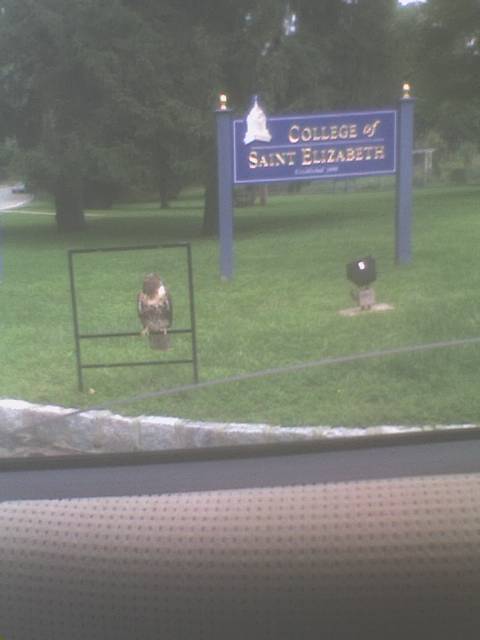
Raptor on CSE Campus

Take Notes: For most families I’ve talked to, the College trip (or trips) becomes a blurred memory.  Keep a journal to help you remember what you liked and didn’t like about certain schools and preserve your memory (and your sanity).

Read one of the “lighter” College Search Books: For every 400 page tome that lists thousands of colleges and millions of bits of data, there is a down-to-earth, light-hearted piece such as Risa Lewak’s “Don’t Stalk the Admissions Officer”.  Grab one, read it and remember that this is not meant to feel like root canal.

Remember, that’s it the Student’s Choice, Too: Your teenager may have a reach school, but your teenager is also somebody’s “reach student”. Don’t forget that your family is the consumer in this process.

SO… Look at this as an exciting journey towards the future, not a dreaded confrontation with the evil world of Admissions Committees.  Research.  Apply.  Review.  But, most of all take a deep breath and…ENJOY!

As always, I welcome your comments, your ratings, your Facebook posts and your emails.  I can be reached at CCRMichael@gmail.com, on Facebook at “College Counseling for the Rest of Us”, on Twitter @MichaelCCR and by cell at 908-403-3819.

Photo of the hawk at the College of Saint Elizabeth is courtesy of yours truly as he rolled down the window of his Saturn and snapped the picture via cellphone, without crashing.

Photo from the Bent Spoon is courtesy of http://lilveggiepatch.com/2010/08/23/sundae-social/

Pairings

5 Comments

Last Thursday, I had the pleasure of attending a Wine Tasting and Luncheon at the Wilshire Grand Hotel, in West Orange. The wines served were all from the Palmaz Vineyards, in Napa Valley. There was a presentation from the co-owner of the Winery, Amalia Palmaz and her son, Palmaz’ co-Director of Operations, Christian Palmaz.

The experience was amazing: the presentation was incredibly informative (yet understandable to a Budweiser and Ballantine drinker like yours truly) and the food and wine pairings were fantastic. I may have tasted the best Chardonnay AND the best Cabernet I’ve ever had in my life.

Swell, Michael, I’m really glad you had a good time, but what does this have to do with College Admissions, College Search, etc. etc. etc.?

I really think there are two very important analogies here.

As I washed the baby field greens and honey roasted walnuts with a dash of Chardonnay, and enjoyed the Cabernet interact with the hoisan glazed french cut chicken and orzo pilaf, I appreciated that the food and wine are meant to complement, not copy, each other.

Thanks, Mike.  I’m working here on a cup of soup, a bag of Doritos and a bottle of water.

And thanks to the Palmaz’ presentation (link here) I much more fully appreciated how much effort goes in to the wine-making process. Not every fruit is selected.  The process takes years. It’s not that there’s waste, but there are ingredients that become more important (and others that become less so) during the maturation process.

So, remember my lunch in West Orange as you journey through your college search.  I think it can benefit you at least two ways:

A) Pick a school and a program that complement you.  It will benefit you greatly in the long-term and give a warm feeling in your belly in the short-term.
B) And remember that you (and your future school) have much to offer each other.  College X or University Y may not take all of the fruits of your labor, but they can take your best offerings and create a legendary vintage.

Or something like that.

As always, I welcome your comments, your ratings, your Facebook posts and your emails.  I can be reached at CCRMichael@gmail.com, on Facebook at “College Counseling for the Rest of Us”, on Twitter @MichaelCCR and by cell at 908-403-3819.

Special thanks to Hilary Morris and Hilary Morris Public Relations and Lori Chiazzo, of The Hip Event, for arranging such a wonderful event!

40 is the New 20: Who is the “typical” College Student?

Leave a comment

Quick quiz: Picture the typical college student.

Do you have the image in your mind? (Don’t close your eyes or you can’t read the rest of the blog!)

I’m guessing the person you’re looking at is about 20 years old, has 2-3 books in hand and is walking on a college quad with beautiful trees. In the background are brick buildings. He or she is probably smiling at the comment made by the person walking alongside.

Well, in the words of some of my college friends from back in the day, fuggedaboutit! That person still exists, but he or she is no more typical a college student in 2010 as…well, as me.  Here’s the skinny…

About half of all college students attend part-time. A similar percentage attend a community college. And about half are financially independent. 38% work full-time. 27% have a dependent of their own.  Only about 25% of college students fit the “traditional” mold. (Data is from the National Center for Educational Statistics, http://nces.ed.gov)

What does this mean for you, as the adult learner? It means that you are not alone.  It means that – particularly if you’re taking your classes at night, online or on weekends (or at your place of employment) – you are taking classes with other “non-traditional” learners.  It means your professors have a greater chance of understanding that you may miss class for a family wedding or a professional conference.  It means – to some extent – the administrative offices of the College (i.e. – Financial Aid, Bursar, Career Services) will have a better grasp of adult concerns, questions, rules and regulations.  (Note: This still varies greatly from school to school, however.)  In general, this is the best time in the history of higher education for a non-traditional student to go to school.

What does this mean for you, the parent of a traditional learner? It means that your child’s classmates could be sharing a range of knowledge and experience in the classroom that wasn’t generally available a generation ago.  But, it does also mean that there is a new group in town that is consuming resources, including financial aid and faculty time and energy.

Attached (I hope) are two wonderful videos regarding the typical student of today.  One is from the fantastic Take America to College video series http://www.takeamericatocollege.com/our-team/dennis-medina/ that tells the story of a Boston Police officer / Community College night student and the other is from the College of Saint Elizabeth that tells the story of a Wall Street professional transitioning to a career as a teacher.   http://www.youtube.com/watch?v=kvoJE_1ffns .

In some ways, higher education is in desperate shape. Costs are skyrocketing, government aid is often being frozen or cut, fund-raising is harder than ever and we are seeing more and more questions about “is college worth the price tag?”.  However, it is also a golden age for higher education. We have an incredibly diverse student population sharing an equally diverse set of experiences and knowledge.  We have educational tools available today that were inconceivable a few years ago.  We have more graduate programs and certifications than in the history of the world.

So, where are we?  At least in terms of college education – 40 is most definitely the new 20, the new “little black dress”, the new grey business suit that anchors the wardrobe.  But it is a wardrobe that is stuffed with multiple styles, shapes, colors and sizes.  It is probably best to simply start trying some things on and see what fits.

Getting In Vs. Staying In

2 Comments

Have you ever heard of an independent retention counselor? I know I haven’t.

But guess which is of these two things is more likely to happen – a) getting an acceptance letter from a college or b) graduating from the college in which you enroll?

The answer is “a”.  More than two-thirds of applications to college are accepted.  But less than 56% of students beginning at a four-year college graduate within (not 4, not 5) 6 years.  If you add in data from 2 year colleges, the numbers are even more dramatic.

It is easier to get in than it is to stay. So, are we focusing too much on the wrong topic?  Are we making poor decisions?  Why is it that almost half of our college choices go astray?

I started in the college admission profession in 1988.  Since then, I’ve seen a dramatic growth in the amount and quality of materials designed and distributed by colleges, the amount of qualified independent college counselors and the amount of college visitations families make during the college search process.  I (and everyone else) have seen the internet make information readily available in ways never before imagined.

So, you’d think we’d be doing alright.  But the statistics say otherwise.

One of my pet peeves is the ever popular quest to get into a reach school.  My philosophy is that you should find the schools that best meet your criteria for success; which colleges are most qualified to get you where you want to go?  However, a common goal among College and Graduate school candidates seems to be to ensure that the students is admitted (and then, attends) the most competitive school to which they can, regardless of fit.

Remember, however, that the reach school is – statistically – the school in which you are the weakest candidate.  You can certainly argue that the statistics aren’t an accurate reflection in your particular situation.  But – in general – many of us are putting quite a bit of effort into being admitted to the school where we are most likely to fail.

In practice, I have seen countless talented students go from a high school experience in which they were in the top 10% or 25% of their senior class to a college experience in which they were in the bottom 25% or 10% of their freshman class.  And that’s when I met them, as they applied to my less-well-kn0wn institution, with a Freshman GPA of 1.9 or 1.4 or some such.

The entire philosophy reminds me of the grand wedding reception that costs a fortune but leaves the newlyweds with months of Ramen Soup dinners and major debt right from the get-go.

Often, we treat college as a very different type of “purchase” from others.  But, in many ways, I find it instructive to make comparisons to other choices in life.

Would you mortgage the house and go into five (or six) figure debt to own the fancy 2 seat sports car if you have a family of 5, with a toddler still in a car seat?

Would you buy the John Deere riding lawn mower with the most bells and whistles, if your property is 40X120?

There are literally 4,000 colleges in this country.  Some are family vans – reliable, comfortable, able to move large groups to their destination.  Some are sports cars – dangerously fast and challenging, but super cool (AND super expensive).  Some are more economical and some have more horse power.  But they all have a purpose and they all have qualities that make them a strong choice for a segment of the student consumer audience.

I would ask of you that you test drive the ones you find as possibilities, and think carefully about what type of educational vehicle will best serve you to reach your ultimate destination.

I welcome your comments – always – and please feel free to email me at CCRMichael@gmail.com, join me on Facebook on “College Counseling for the Rest of Us” and join me on Twitter at @MichaelCCR.

NOTES: Admission data is courtesy of the National Association of College Admission Counseling’s “State of College Admission 2010” Report, available at http://www.nacac.org. (http://www.nacacnet.org/PublicationsResources/Marketplace/research/Pages/StateofCollegeAdmission.aspx)
Persistence Data is courtesy of the College Board’s College Completion Agenda 2010 Progress Report.

The Rest of Us

2 Comments

This is either the first blog in what will become a vastly successful college counseling business for “the rest of us” – the adults going back to school, the families who have never gone through the college admission process before, the parents whose child is not going to Harvard or Yale, the young professionals trying to pick a grad school – or if they should go to grad school, or…

Or it’s a brief footnote to an upstart that didn’t make it.

At this point, I don’t know which will prove true.  But I can tell you that if I don’t succeed, someone else will.

Listening to thousands of parents and adult students (with many wearing both hats), two things are obvious to me: a) people have more information about college available to them than ever before and b) they are getting less guidance on how to use that information.

This is not a knock on college counselors or guidance personnel, nor is it a comment on the families involved.  In the 23 years that I have worked in college admission, enrollment and financial aid, the amount of materials – both paper and electronic – that we produce has grown enormously.  “Many trees die”, you might say, in the quest to promote Colleges to potential students.  The tenor of these materials has also changed dramatically – the soft sell (dare we used that word – “sell” – 10-15 years ago!) of the 1980’s has given way to aggressive promotional techniques, often at the expense of providing meaningful information about the institutions we promote.  Paper catalogs were deemed too expensive, but pens, flash drives and Frisbees became commonplace.

As well, the entire process has become far more complex.  Standards for many public colleges have risen dramatically while the numbers for many private colleges have declined.  The College Visit has become its own pocket industry.  An economist should do a supply and demand study about College Admission in the past two decades (maybe one has and I’ve missed it; have to do some investigating).  It would be fascinating for its ebbs and flows, its contradictions, its own special pulse.

Well, anyway, I’m going to start my first blog under Joba rules, and keep this under 500 words.  I hope I can provide a valuable service in the years to come for the adults going back to school, the families who have never gone through the college admission process before, the parents whose child is not going to Harvard or Yale, the young professionals trying to pick a grad school – or if they should go to grad school.

I welcome your comments – always – and please feel free to email me at CCRMichael@gmail.com, join me on Facebook on “College Counseling for the Rest of Us” and join me on Twitter at @MichaelCCR.

“See” you next week!

Newer Entries