Community Colleges Deserve an “A”

3 Comments

Comments: A pleasure.  Exhibits talent and creativity.  Maintains a positive attitude.  Is responsible and hard-working.

Currently, over 40% of all college students are enrolled at a community college.  That’s nearly 6 MILLION people.  For reasons both new and old, Community Colleges have never been more important to American higher education, nor has their reputation been stronger than it is in 2010.

Comments: Overlooked or dismissed out of hand.

But, too often, community colleges are not on a prospective student’s “radar” when they would make a legitimate, affordable and appropriate option.  They are overlooked or dismissed out of hand.  And I think this is a mistake that unnecessarily limits many adult and traditional students’ options.

Let’s take a look at the grades.  From what I can see, it’s all “straight A’s”:

A – AMERICAN.  While universities were existence long before Columbus did, or did not, discover America, community colleges – while in existence elsewhere – are by and large an American creation of the 20th century.  They were built to serve the tired, the poor, the masses.  And they still do, with an independence and pride that reminds one of their roots.

A – ACCESS. Community Colleges were meant to provide education to people who would not otherwise go to college.  In an age when college has increasingly become a necessary “tool in the tool belt” for the individual seeking employment, community colleges, while still providing certificates and associate degrees have become even more important as a proper gateway to bachelor degrees.  In fact, there is now growth in the area of 2+2+2 programming – community college to Masters tracts.

A – AFFORDABLE. In the economy we currently live in, the low-cost option of community colleges is as relevant as it has ever been.

A – ADULTS – Although an important part of the community college enrollment growth of the 21st century has been traditional students, adult students – part of the reason community colleges developed in the first place – continue to be vital to the success of these schools.  Community Colleges have programs, services and schedules designed to meet the needs of adults.

A- ADAPTIVE – And Community Colleges are poised to continue to meet those needs.  With a commitment to serving the local community and serving students of all ages, they have the initiative and skills to adjust to changes in professional fields, implement new modes of academic delivery and provide resources for new learning styles, methods and concerns.

A – ACCEPTED – Maybe the “A” that they can be most proud of, Community Colleges are increasingly accepted for the value of what they do.  In New Jersey, it’s called “full faith in transfer’.  But most other colleges have a variation on the same theme.  If you finish an associate degree in New Jersey and move on to a 4-year college in New Jersey, your credits are accepted in “full faith”.  You come in as a junior.  This was not always the case.  But now, it is increasingly harder to argue why you don’t want to take a course for $300 at the community college that would cost $1000, $2000 or $3000 at a four-year institution.  For more information on transferring from a community college in New Jersey to a 4-year institution, check out http://www.njtransfer.org/

A – ALWAYS.  Today, more and more of us are becoming “lifetime learners”.  It might be a Masters or Doctoral degree.  But it might also be a professional certificate to gain a management position or to change careers.  It might be a set of business courses with a specific skill set.  It might be a course or two (credit or non-credit) in an area we always wanted to learn more about (ceramics, the 60’s, family nutrition).    And those are all areas where the community college can provide a convenient, affordable choice.

So, based on their last report card, I have to say that – whether you are 17, 47 or 97 – community colleges are a great option to further your education.

Below is a link to a great video promoting the benefits of community colleges, including Nassau Community College alumnus Billy Crystal and Jim Lehrer, Victoria College alum.

http://www.huffingtonpost.com/arne-duncan/community-colleges-the-ga_b_752982.html

The College Search is Not the College “Search and Destroy Each Other”

3 Comments

I feel the need to share a secret.

The College Search process is actually supposed to enjoyable.

No, really.

The College Search is a chance to visit new places, to explore new options and answer the Zen-like “whatdoyouwanttobewhenyougrowup” question.  It’s a chance to choose what courses you want to take and where you want to take them.

Most of my readers are from New Jersey.  And, historically, New Jersey has a reputation as an “exporter” in the college student industry.  But ignoring the options available in the Garden State is a big mistake.  New Jersey has over 50 great colleges –  35 offering bachelor’s degrees and 19 community colleges.  They come in all shapes, sizes, locations and styles.

Here are a few tips to help you make the process more satisfying and enjoyable and less nerve-wracking and argument inducing…

Treat the College Guides Like They Are Your Favorite Catalogs: It IS a shopping trip, you know.  Flip through the college guides, search through the online search services, read the colleges’ viewbooks, watch the videos (maybe pop some popcorn for the viewing), and check out the Colleges’ websites and Facebook pages.

Enjoy the Trip: You and your student are probably going to visit places you’ve never been to before.  Don’t forget to grab some ice cream, in Princeton, at Thomas Sweets or the Bent Spoon.  Travel through 3 college campuses (Drew, FDU and College of Saint Elizabeth) within a 1.6 mile stretch on Madison Avenue, in Morris County.  Visit Union, home of Kean University and the world’s largest watersphere.  Treat the trip like a great metaphor – enjoy the journey as well as the destination.  On that note…

The Bent Spoon's Bourbon Vanilla with Sea Salt Caramel

The Bent Spoon's Bourbon Vanilla with Sea Salt Caramel

Take Pictures: Be the tourist. Record your trip.  (Just don’t embarrass your kid too much.)  And it will help when you come back home and try to remember which school had the cool student center or residence halls (or horrendous parking lots or not-so-attractive surrounding neighborhood).  Maybe, while in Hackettstown, you’ll catch a picture of Tilly, Centenary College’s (in)famous ghost.

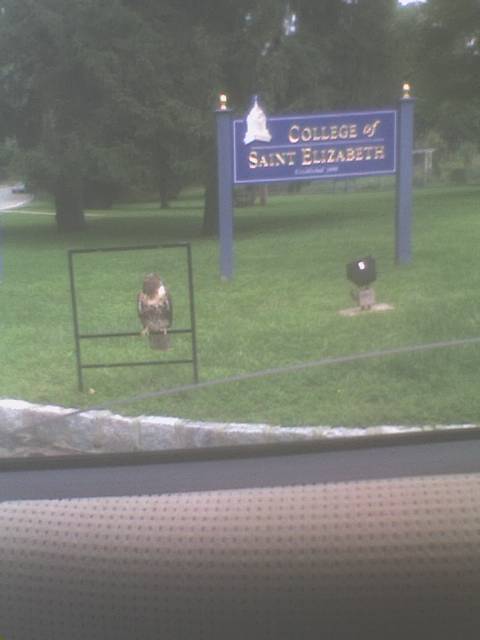
Raptor on CSE Campus

Take Notes: For most families I’ve talked to, the College trip (or trips) becomes a blurred memory.  Keep a journal to help you remember what you liked and didn’t like about certain schools and preserve your memory (and your sanity).

Read one of the “lighter” College Search Books: For every 400 page tome that lists thousands of colleges and millions of bits of data, there is a down-to-earth, light-hearted piece such as Risa Lewak’s “Don’t Stalk the Admissions Officer”.  Grab one, read it and remember that this is not meant to feel like root canal.

Remember, that’s it the Student’s Choice, Too: Your teenager may have a reach school, but your teenager is also somebody’s “reach student”. Don’t forget that your family is the consumer in this process.

SO… Look at this as an exciting journey towards the future, not a dreaded confrontation with the evil world of Admissions Committees.  Research.  Apply.  Review.  But, most of all take a deep breath and…ENJOY!

As always, I welcome your comments, your ratings, your Facebook posts and your emails.  I can be reached at CCRMichael@gmail.com, on Facebook at “College Counseling for the Rest of Us”, on Twitter @MichaelCCR and by cell at 908-403-3819.

Photo of the hawk at the College of Saint Elizabeth is courtesy of yours truly as he rolled down the window of his Saturn and snapped the picture via cellphone, without crashing.

Photo from the Bent Spoon is courtesy of http://lilveggiepatch.com/2010/08/23/sundae-social/

Pairings

5 Comments

Last Thursday, I had the pleasure of attending a Wine Tasting and Luncheon at the Wilshire Grand Hotel, in West Orange. The wines served were all from the Palmaz Vineyards, in Napa Valley. There was a presentation from the co-owner of the Winery, Amalia Palmaz and her son, Palmaz’ co-Director of Operations, Christian Palmaz.

The experience was amazing: the presentation was incredibly informative (yet understandable to a Budweiser and Ballantine drinker like yours truly) and the food and wine pairings were fantastic. I may have tasted the best Chardonnay AND the best Cabernet I’ve ever had in my life.

Swell, Michael, I’m really glad you had a good time, but what does this have to do with College Admissions, College Search, etc. etc. etc.?

I really think there are two very important analogies here.

As I washed the baby field greens and honey roasted walnuts with a dash of Chardonnay, and enjoyed the Cabernet interact with the hoisan glazed french cut chicken and orzo pilaf, I appreciated that the food and wine are meant to complement, not copy, each other.

Thanks, Mike.  I’m working here on a cup of soup, a bag of Doritos and a bottle of water.

And thanks to the Palmaz’ presentation (link here) I much more fully appreciated how much effort goes in to the wine-making process. Not every fruit is selected.  The process takes years. It’s not that there’s waste, but there are ingredients that become more important (and others that become less so) during the maturation process.

So, remember my lunch in West Orange as you journey through your college search.  I think it can benefit you at least two ways:

A) Pick a school and a program that complement you.  It will benefit you greatly in the long-term and give a warm feeling in your belly in the short-term.
B) And remember that you (and your future school) have much to offer each other.  College X or University Y may not take all of the fruits of your labor, but they can take your best offerings and create a legendary vintage.

Or something like that.

As always, I welcome your comments, your ratings, your Facebook posts and your emails.  I can be reached at CCRMichael@gmail.com, on Facebook at “College Counseling for the Rest of Us”, on Twitter @MichaelCCR and by cell at 908-403-3819.

Special thanks to Hilary Morris and Hilary Morris Public Relations and Lori Chiazzo, of The Hip Event, for arranging such a wonderful event!

Unexpected Friends on the Journey

3 Comments

The College Search can be a fascinating journey.

And much of the experience is yours, and yours alone.  But, to assist you in your quest, you may find some unexpected friends.  These allies come in varied shapes and sizes.  I’m talking – of course – of blogs and tweets and books and websites.

BLOGS: Academics like to write.  And they like to think they are good at writing.  Luckily, they generally are.  There is a plethora (SAT word!) of interesting blogs that relate to college admissions, and college life, in general.  http://onlineuniversityrankings2010.com/2010/top-50-college-admission-administration-blogs/ lists just that – a fairly diverse list of college blogs, divided into four groups: Administration, Admissions, Advice, Scholarships and Financial Aid, and Grad School Admissions.

TWEETS: Twitter accounts can come and go, and Twitter is not for everyone.  But I find it often provides quick leads to important, timely information.  Some of the Twitter accounts that I follow regularly include: @USHigherEdu @Chronicle @mycollegeguide and @Talkingteenage.  But the most relevant info for you is probably going to come from the tweets coming from the schools you are interested in.  The hardest part, in some cases, is identifying which twitter account (or Facebook page, for that matter) is the “official” one for the College.  There are often multiple choices and it may be hard to ascertain which is the one you should follow.

BOOKS: Currently on my desk are three great books relating to the College Search – “The Fiske Guide to Colleges”, the Princeton Review’s “K&W Guide to Colleges for Students with Learning Disabilities or ADHD” and “Don’t Stalk the Admissions Officer”.  But there are College guides of all shapes and sizes – serious and lighthearted, books about admissions and books about financial aid, guides sorted by major and guides sorted by geography.

WEBSITES: There are certain links you will see over and over again on my Facebook page.  I tend to think of the two “anchors” to be the New York Times (www.nytimes.com) and the Chronicle of Higher Education (www.chronicle.com).  Both have daily education news and weekly articles and blogs about the admission process.  But I notice that a third site, http://www.insidehighered.com, gets a lot of play on my page – with good reason.  It’s another great source of education news and admission info.  But, much like the Twitter accounts, the most relevant websites for YOU will probably be the College websites for the schools you are looking at.

The blogs and tweets and websites are free.  The books are not, but are a small investment in the bigger picture.  And all of them – the blogs, the twitterers, the websites and the books – are all there to help guide you to your destiny.  I wish you safe passage.

As always, I welcome your comments, your ratings, your Facebook posts and your emails.  I can be reached at CCRMichael@gmail.com, on Facebook at “College Counseling for the Rest of Us”, on Twitter @MichaelCCR and by cell at 908-403-3819.

Getting In Vs. Staying In

2 Comments

Have you ever heard of an independent retention counselor? I know I haven’t.

But guess which is of these two things is more likely to happen – a) getting an acceptance letter from a college or b) graduating from the college in which you enroll?

The answer is “a”.  More than two-thirds of applications to college are accepted.  But less than 56% of students beginning at a four-year college graduate within (not 4, not 5) 6 years.  If you add in data from 2 year colleges, the numbers are even more dramatic.

It is easier to get in than it is to stay. So, are we focusing too much on the wrong topic?  Are we making poor decisions?  Why is it that almost half of our college choices go astray?

I started in the college admission profession in 1988.  Since then, I’ve seen a dramatic growth in the amount and quality of materials designed and distributed by colleges, the amount of qualified independent college counselors and the amount of college visitations families make during the college search process.  I (and everyone else) have seen the internet make information readily available in ways never before imagined.

So, you’d think we’d be doing alright.  But the statistics say otherwise.

One of my pet peeves is the ever popular quest to get into a reach school.  My philosophy is that you should find the schools that best meet your criteria for success; which colleges are most qualified to get you where you want to go?  However, a common goal among College and Graduate school candidates seems to be to ensure that the students is admitted (and then, attends) the most competitive school to which they can, regardless of fit.

Remember, however, that the reach school is – statistically – the school in which you are the weakest candidate.  You can certainly argue that the statistics aren’t an accurate reflection in your particular situation.  But – in general – many of us are putting quite a bit of effort into being admitted to the school where we are most likely to fail.

In practice, I have seen countless talented students go from a high school experience in which they were in the top 10% or 25% of their senior class to a college experience in which they were in the bottom 25% or 10% of their freshman class.  And that’s when I met them, as they applied to my less-well-kn0wn institution, with a Freshman GPA of 1.9 or 1.4 or some such.

The entire philosophy reminds me of the grand wedding reception that costs a fortune but leaves the newlyweds with months of Ramen Soup dinners and major debt right from the get-go.

Often, we treat college as a very different type of “purchase” from others.  But, in many ways, I find it instructive to make comparisons to other choices in life.

Would you mortgage the house and go into five (or six) figure debt to own the fancy 2 seat sports car if you have a family of 5, with a toddler still in a car seat?

Would you buy the John Deere riding lawn mower with the most bells and whistles, if your property is 40X120?

There are literally 4,000 colleges in this country.  Some are family vans – reliable, comfortable, able to move large groups to their destination.  Some are sports cars – dangerously fast and challenging, but super cool (AND super expensive).  Some are more economical and some have more horse power.  But they all have a purpose and they all have qualities that make them a strong choice for a segment of the student consumer audience.

I would ask of you that you test drive the ones you find as possibilities, and think carefully about what type of educational vehicle will best serve you to reach your ultimate destination.

I welcome your comments – always – and please feel free to email me at CCRMichael@gmail.com, join me on Facebook on “College Counseling for the Rest of Us” and join me on Twitter at @MichaelCCR.

NOTES: Admission data is courtesy of the National Association of College Admission Counseling’s “State of College Admission 2010” Report, available at http://www.nacac.org. (http://www.nacacnet.org/PublicationsResources/Marketplace/research/Pages/StateofCollegeAdmission.aspx)
Persistence Data is courtesy of the College Board’s College Completion Agenda 2010 Progress Report.

The Rest of Us

2 Comments

This is either the first blog in what will become a vastly successful college counseling business for “the rest of us” – the adults going back to school, the families who have never gone through the college admission process before, the parents whose child is not going to Harvard or Yale, the young professionals trying to pick a grad school – or if they should go to grad school, or…

Or it’s a brief footnote to an upstart that didn’t make it.

At this point, I don’t know which will prove true.  But I can tell you that if I don’t succeed, someone else will.

Listening to thousands of parents and adult students (with many wearing both hats), two things are obvious to me: a) people have more information about college available to them than ever before and b) they are getting less guidance on how to use that information.

This is not a knock on college counselors or guidance personnel, nor is it a comment on the families involved.  In the 23 years that I have worked in college admission, enrollment and financial aid, the amount of materials – both paper and electronic – that we produce has grown enormously.  “Many trees die”, you might say, in the quest to promote Colleges to potential students.  The tenor of these materials has also changed dramatically – the soft sell (dare we used that word – “sell” – 10-15 years ago!) of the 1980’s has given way to aggressive promotional techniques, often at the expense of providing meaningful information about the institutions we promote.  Paper catalogs were deemed too expensive, but pens, flash drives and Frisbees became commonplace.

As well, the entire process has become far more complex.  Standards for many public colleges have risen dramatically while the numbers for many private colleges have declined.  The College Visit has become its own pocket industry.  An economist should do a supply and demand study about College Admission in the past two decades (maybe one has and I’ve missed it; have to do some investigating).  It would be fascinating for its ebbs and flows, its contradictions, its own special pulse.

Well, anyway, I’m going to start my first blog under Joba rules, and keep this under 500 words.  I hope I can provide a valuable service in the years to come for the adults going back to school, the families who have never gone through the college admission process before, the parents whose child is not going to Harvard or Yale, the young professionals trying to pick a grad school – or if they should go to grad school.

I welcome your comments – always – and please feel free to email me at CCRMichael@gmail.com, join me on Facebook on “College Counseling for the Rest of Us” and join me on Twitter at @MichaelCCR.

“See” you next week!

Newer Entries